Tracks
Track |
Time |
Play |
| Prelude: My Lover Called | 01:20 | |
| Days of Cold Are Past | 02:22 | |
| Prelude: The Dove Knows Her Mate | 02:29 | |
| Distant Dove | 03:59 | |
| Elegy | 01:36 | |
| Prelude: Birds Struggle | 02:48 | |
| Avi, Avi | 04:06 |
Liner Notes
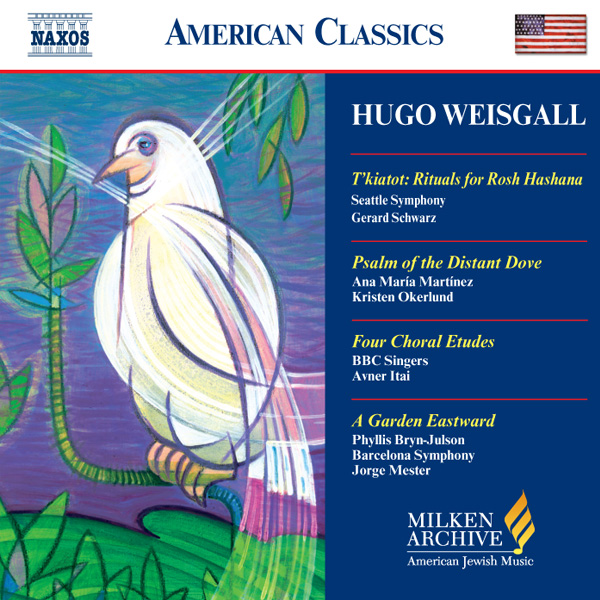
In Weisgall’s last years, his work dealt increasingly with Jewish life and Jewish subjects and issues. His last opera, Esther, concerned a biblical subject; his last choral work was a large-scale sacred service; and his last long song cycle was Psalm of the Distant Dove: Canticle in Homage to Sephardi Culture. This was commissioned by the Friends of the Library of the Jewish Theological Seminary, where it was premiered in 1992. Raymond P. Scheindlin, a professor there of medieval Hebrew literature and one of the foremost authorities on the subject (as well as on Arabic poetry), selected and translated the poetry; and his wife, mezzo-soprano Janice Meyerson, sang in that performance, with Brian Zeger at the piano.
The literary and religious issue of Psalm of the Distant Dove is the complicated, age-old relationship between God and His loving but suffering people Israel, poetically represented here by the image of the dove. Throughout Mediterranean literature—and especially Arabic poetry—doves are associated with lovers. They do not abandon their life partners. Weisgall’s cycle alternates three short selections—which he calls preludes—from the biblical Song of Songs and from Midrash Raba (rabbinic commentaries on the Holy Scriptures, often by way of allegory and metaphor, dating to the 5th–6th centuries C.E.) with poetry from the so-called Golden Age of Spanish Jewry in the era of Moslem rule on the Iberian Peninsula. That poetry is drawn from verse by three poets: Shmuel Ha’Naggid [Ismail ibn Nagrela, ca. 993–1055], statesman and leader of Spanish Jewry, military commander, vizier of Granada, and poet and Hebraic scholar; Yehuda [Judah] Halevi, probably the most widely recognized and familiar Hebrew poet and philosopher from that era; and an anonymous poet.
Specific literary connections lead the listener from one section of the cycle to the next, and it concludes with aching cries for the redemption of Israel, as the poet painfully recalls the more joyful passing of seasons from the first prelude from Song of Songs. In the prelude and its pendant excerpt from Midrash Raba 1:15, for example, Weisgall symbolizes the joy of friends or lovers—or the steadfast loyalty God reserves for His “mate” Israel—with rearranged fourth chords that yield quasi-diatonic tonal areas. By contrast, the bittersweet, biting harmonies of the spring song, “Days of Cold Are Past”; the plaint of the injured lover, “Distant Dove”; and the prelude from Midrash Raba, “Birds Struggle in the Hand of the Slaughterer,” owe more to the type of half-step intervallic units found in Esther. There seems to be an overall harmonic motion from open, optimistic, even Coplandesque chords and melodies to more craggy, dissonant structures toward the end. The final song concludes with a very dissonant seven-note chord, which is a denser version of the one heard at the opening of the cycle (“My Lover Called...”).
Two thirds of the way into the work, there is a solo piano “Elegy,” in three intimate, spare melodic voices, subtitled “In Memoriam W S (William Schuman). February 15th, 1992” in tribute to a colleague and one of the most significant 20th-century American composers. (This marked the last in a years-long series of short piano pieces that Weisgall composed upon the deaths of friends: Sessions, Randolph Rothschild, and others.) In fact, the entire cycle exhibits a concentrated, rather austere style of piano writing that avoids sumptuous pianistic sonorities and coloristic exploitation of the pedal. This, together with deliberate avoidance of the extreme registers on the piano, serves the composer’s focus on the vocal line and the sternness of the message contained in the aggregate text.
Editor’s Note by Neil W. Levin
The final song is excerpted from an anonymous Sephardi dirge or elegy (kina) traditionally sung on Tisha Ba’av—the ninth of the Hebrew month of av—which commemorates the destruction of both ancient Temples in Jerusalem in 566 B.C.E. and 72 C.E. and also, for Sephardi Jewry, the expulsion from Spain in 1492. In fact, this poem, borei ad ana, is one of the best known of all the Sephardi kinot. Its acrostic spells out the name Binyamin (Benjamin), presumably the anonymous unidentified poet. The poem appears to have been written with specific reference to the wave of Christian persecutions against Jews in Spain between 1391 and 1412. It contains various biblical references and quotations, and its original text also contained a reference to the Christian concept of the Trinity: “The worshippers of three gods—father, son, and spirit ...” That passage was later modified, either by outside censors or by Jewish authorities, to read “Cruel aliens [strangers] weakened her...” There are various modifications of that line in extant compilations.
Lyrics
Sung in English
PRELUDE: MY LOVER CALLED
Song of Songs 2:10
My lover called: rise up my love, rise up my love and come with me.
Rise up my love and come with me.
The rains have passed, the trees are in bud, the doves have come again, the doves have come again!
DAYS OF COLD ARE PAST
Shmuel Hannagid
Days of cold are past, and spring has buried winter’s rain.
Doves are sighted in the land, flocking to every bough.
O friends, be true.
Come quickly, do not fail a friend.
Come into my garden: there pluck the rose.
There, amid the buds and birds that flock to sing the summer’s praise, drink with me, drink with me wine, red as the blush on lovers’ cheeks, wine, red as the tears for friends that are gone.
THE DOVE KNOWS HER MATE
Midrash Raba, Song of Songs 1:15
The dove knows her mate and never changes him for another.
Israel knows God as her mate forever.
DISTANT DOVE
Yehuda Halevi
Distant dove wandered to a wood, stumbled there and lay lame, flitted, flailed, and flustered, circling her love’s head.
Her lover hurt her, left her; she might have died.
She swore she’d never breathe his name again—
But in her heart it burned like fire.
Why so hostile to her?
Her mouth is ever open to your rain.
She keeps her faith, does not despair.
Whether in Your name her lot is shame or glory.
Come God now, and come not softly but raging mid storms and wild flames.
ELEGY
In memoriam W. S., Feb. 15, 1992
Solo piano
PRELUDE: BIRDS STRUGGLE
Midrash Raba, Song of Songs 1:15
Birds struggle in the hands of the slaughterer, but the dove puts out its neck to be slaughtered.
Like Israel, as it is written for your sake.
We are slaughtered all the day.
AVI, AVI (MY FATHER, MY FATHER)
Anonymous
O God, how long will You leave Your dove, will You leave Your dove in the trap, in the snare—there to remain far from her young, crying, “My father, my father!”
Your dove wandered away from her nest in the frost of the night, in the heat of the day.
She shudders to think of the steel of the sword, of the lion’s fang.
You left her, God, in the hands of the beast.
He parted her neck bone; he fed on her throat.
Summers and winters have come and gone.
I bend to his yoke.
If only she could have the eagle’s wing to fly over mountains, to soar over hills, to come with her love to his chamber alone, I would forget my pain.
Credits
Composer: Hugo WeisgallPerformers: Ana María Martínez, Soprano; Kristin Okerlund, Piano
Publisher: Theodore Presser Co.
Texts compiled and translated: Raymond P. Scheindlin